


Release of SB-12RII, a Swiss-Type Automatic Lathe
—New model of the SB Series that realizes the capabilities required for small-diameter machining—
Star Micronics Co., Ltd. (Head Office: Suruga-ku, Shizuoka-shi, Shizuoka; Representative Director, President and Chief Executive Officer: Mamoru Sato) has developed the “SB-12RII,” a new model in the SB Series of Swiss-type automatic lathes(*1)with a maximum machining diameter of 13 mm, and will begin sales targeting the machining of small-diameter precision parts for applications such as medical devices, connectors, and humanoid robots.
The SB Series is our best-selling series of machines, with cumulative sales exceeding 30,000 units since the initial model went on sale in 2003, and has been used to machine parts for a wide range of industries, including those for automobiles, information and communications equipment, and medical devices. The newest model, “SB-12RII,” is the successor to the “SB-12 R type G” (hereinafter referred to as the “previous model”), which has earned high acclaim in the market as a small-diameter machining model of the series.
With this model update, we have raised the maximum rotational speed of the power-driven tools in the tool post for front-end machining, and have enhanced the output of both the sub spindle motor and the power-driven tool motor for rear-end machining. By strengthening each function, we have further improved the machining quality and production efficiency required to machine small-diameter precision parts. In addition, by extending the maximum length of parts that can be clamped by the sub spindle from 80 mm to 105 mm, we are able to meet the diverse needs in the growing and evolving field of small-diameter parts machining.
■Release date
Sales to begin sequentially domestically and overseas, starting from spring 2027
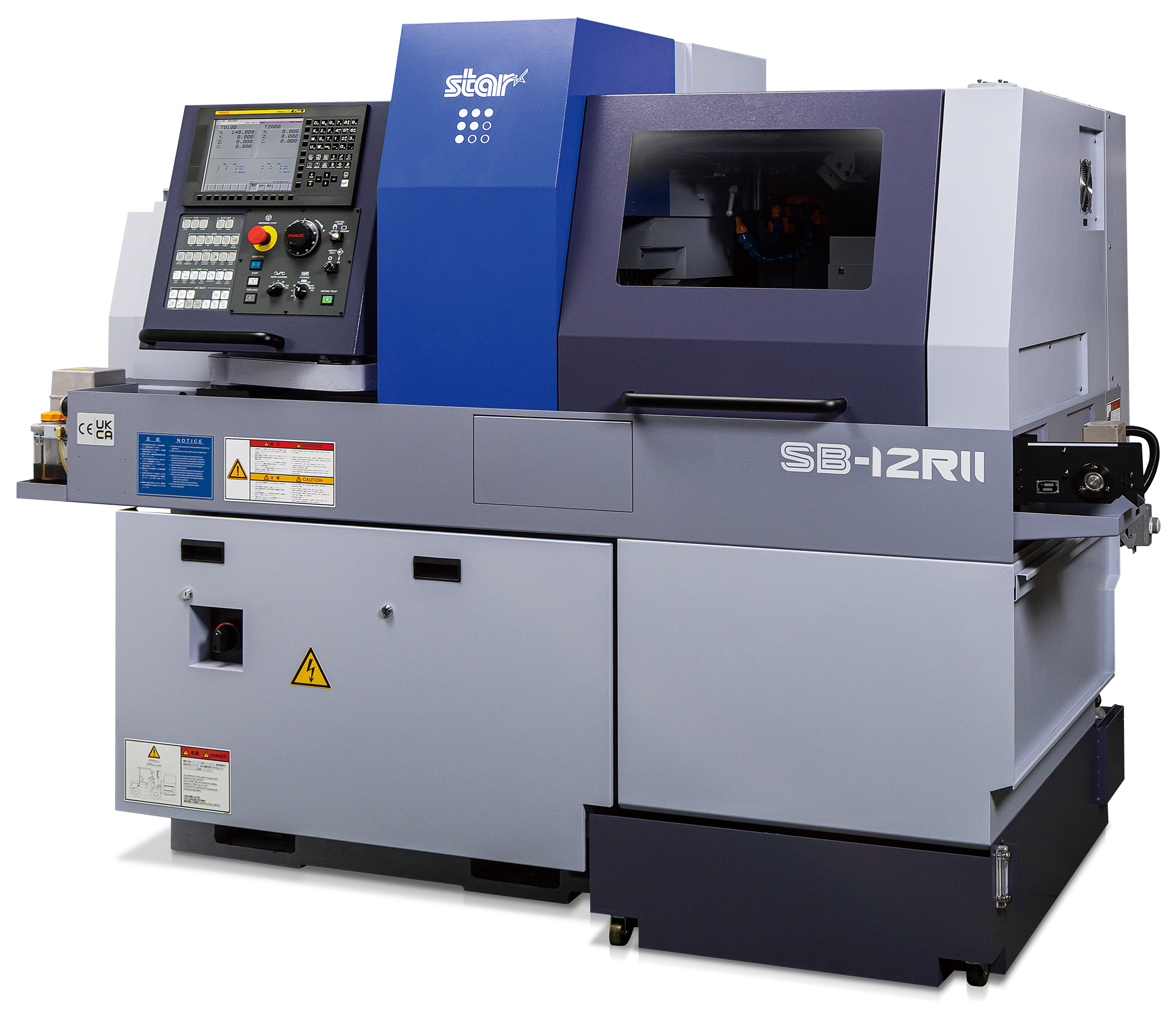
Main features
1. High-rigidity tool post utilizing proprietary technology
The tool post for front-end machining incorporates our proprietary “slant-type dovetail slideway structure” which offers high rigidity. By reducing the load generated during cutting, continuous machining with consistent precision over a long period is achieved.
2. Guide bush/Non-guide bush(*2) changeover mechanism
The specification can be switched to suit the total length of parts to be machined. For long parts, the guide bush specification can be used to act as a steady rest for materials, enabling machining of high precision with minimal workpiece deflection. For short parts, the non-guide bush specification can be used to reduce the amount of scrap material, leading to lower materials costs.
3. Broad range of tooling variations
A cartridge-type, 5-spindle cross-drilling unit is employed on the tool post for front-end machining.Various tool units can be mounted on the three compatible cartridge positions to match the shape of machined parts.
4. Newly-developed tool units to expand tooling options
1) Skewed hole machining unit (optional)
A first in the SB Series. This optional unit enables angular machining such as the drilling of angled holes, supporting complex, multi-step machining of small-diameter parts.
2) High-speed thread whirling (for thread cutting) unit (optional/under development)
With a maximum speed of 5,000 min-1, this unit helps reduce cycle times and improve machined surface quality when machining small-diameter screws.
5. High-precision sub collet sleeve (cylindrical component that holds the collet)
The high dimensional accuracy of the collet sleeve for the sub spindle helps minimize misalignment during sub collet installation, realizing small-diameter machining that is both consistent and highly precise.
6. Improved rear-end machining capability
The output of the sub spindle motor has been increased to roughly three times that of the previous model, while the motor output for rear-end power-driven tools has been increased from 0.75 kW to 1.0 kW. Additionally, a built-in sensor provides high-precision C-axis positioning.
7. Optional accessories for high-precision small-diameter machining
1) Tool post spacer (optional)
By attaching a tool post spacer when using the boss-length guide bush (a guide bush with an extended tip), the cutting edges of turning tools and power-driven tools can be positioned closer to the guide bush. This reduces workpiece deflection caused by cutting loads, achieving highly precise small-diameter machining.
2) Two types of sleeve holders (standard option)
In addition to the existing sleeve holder with a 76 mm clearance from the guide bush, a new model with a shorter clearance of 60 mm has been added to the lineup. Each sleeve holder can be selected based on the shape of the machined part.
8. Space-saving design
The machine’s footprint has been reduced by approximately 10% compared to the previous model, making it easier to install in factories with limited floor space.
Main Specifications
| Item | Specification | |
|---|---|---|
| Max. machining diameter | 13mm dia | |
| Max.headstock stroke | Guide bush specification | 205mm |
| Non-guide bush specification | Material dia. x 2.5 (Max. 30 mm) | |
| Main spindle | Max. speed | 15,000min-1 |
| Motor output | 2.2kW/3.7kW | |
| Sub spindle | Max. speed | 12,000min-1 |
| Motor output | 1.5kW/2.2kW | |
| Cross-drilling power driven tool | Max. speed | 8,000/12,000min-1 |
| Motor output | 1.2kW | Rear-end power driven tool | Max. speed | 8,000min-1 |
| Motor output | 1.0kW | |
| Machine dimensions (W × D × H) | 2,070 mm × 1,095 mm × 1,775 mm | |
(*1) What is a Swiss-type automatic lathe?
The Swiss-type automatic lathe is a type of lathe that rotates materials such as metal, and presses a cutting instrument against the materials to cut them. It was invented in Switzerland in the 1870s as a machine for machining small precision parts such as watch parts. It is also called a “spindle-moving type automatic lathe”. It is characterized by the ability to cut long narrow parts with high precision due to the material grasped by the spindle unit being machined while fed at a certain distance from the guide bush, which acts as a material run-out prevention device.
(*2) What is the non-guide bush specification?
The non-guide bush specification is a Swiss-type automatic lathe with the guide bush that acts as a material run-out prevention device removed. It is unsuitable for machining of long narrow parts, however, in the case of short parts that do not deflect even without a guide bush, the length of leftover material that is discarded without being able to be machined due to the machine structure can be reduced to about one-third of the length generated with the guide bush specification.